
Cantonese Roasted Duck
Cantonese roasted duck (广式烤鸭). After a lot of trial and error and taste-testing, the author perfected this marinade, which makes the duck taste exactly like a Cantonese restaurant. With the secret glaze formula the duck has the crispiest skin and a beautiful reddish-brown color, just like the ones hanging in front of the roast shops in Chinatown. Chef's Secret: Cantonese-style roasted duck is unique with onion soup inside, making it juicy and perfect for dipping over rice; the key is to saute the onions before roasting, as the oven time isn't sufficient otherwise.
Ingredients
| 12.5 g | Sugar (for crispy glaze) |
| 23 g | Maltose |
| 85 g | Vinegar |
| 168 g | Chinese cooking wine |
| 3.3 g | Black peppercorns (for spice blend) |
| 1.3 g | Whole Sichuan peppercorns |
| 0.4 g | Star anise |
| 0.4 g | Bay leaves |
| 2.5 g | Cinnamon stick |
| 0.4 g | Dried gancao (licorice root) |
| 0.8 g | Dried sand ginger |
| 1 g | Aged tangerine peel |
| 11.4 g | Salt (to season the duck) |
| 8.3 g | Sugar (to season the duck) |
| 25 g | Soy sauce |
| 21 g | Hoisin sauce |
| 16 g | Zhuhou paste |
| 20 g | Fermented bean curd |
| 34 g | Cooking oil (to saute the onion) |
| 280 g | Sweet onion, diced |
| 18 g | Garlic, minced |
| 15-18 g | Ginger slices |
| 1.8 kg | Whole duck |
| 15 g | Scallion |
| 12 g | Cilantro leaves |
| 1 | Metal skewer |
| 1 | Electric portable air compressor with nozzle adaptor |
Instructions
This is a more elaborate dish, so read through the steps and ingredients before you begin. Ingredient tips: maltose can be replaced by honey; non-alcohol replacement for Chinese cooking wine here can be the same amount of water; aged tangerine peel can be replaced by lemon zest; choose a head-on duck if possible (headless ones usually have the neck cut off, which affects air-pumping); if using a frozen duck, defrost in the refrigerator at least 36 hours.
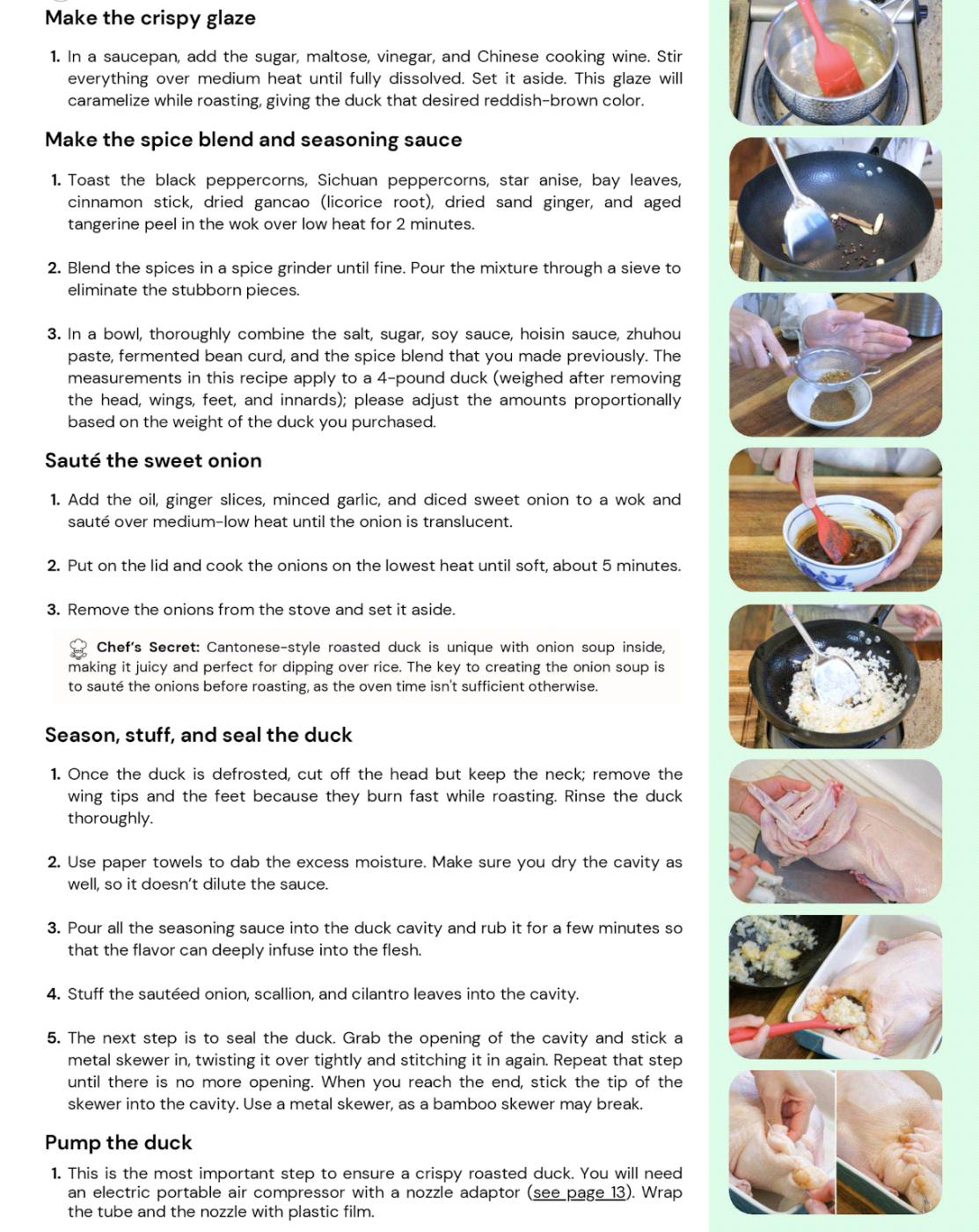
Make the crispy glaze: In a saucepan, combine the sugar, maltose, vinegar, and Chinese cooking wine. Stir over medium heat until fully dissolved, then set aside. This glaze caramelizes while roasting, giving the reddish-brown color.
Make the spice blend and seasoning sauce: 1) Toast the black peppercorns, Sichuan peppercorns, star anise, bay leaves, cinnamon stick, dried gancao, dried sand ginger, and aged tangerine peel in the wok over low heat for 2 minutes. 2) Blend the spices in a grinder until fine, then pour through a sieve to remove stubborn pieces. 3) In a bowl, combine salt, sugar, soy sauce, hoisin sauce, zhuhou paste, fermented bean curd, and the spice blend. (Measurements apply to a 4-pound duck weighed after removing head, wings, feet, innards; adjust proportionally.)
Saute the sweet onion: 1) Add the oil, ginger slices, minced garlic, and diced sweet onion to a wok and saute over medium-low heat until translucent. 2) Put on the lid and cook on lowest heat until soft, about 5 minutes. 3) Remove and set aside.
Season, stuff, and seal the duck: 1) Once defrosted, cut off the head but keep the neck; remove wing tips and feet (they burn fast). Rinse thoroughly. 2) Pat dry, including the cavity, so it doesn't dilute the sauce. 3) Pour all the seasoning sauce into the cavity and rub a few minutes to infuse. 4) Stuff the sauteed onion, scallion, and cilantro into the cavity. 5) Seal the duck: grab the cavity opening and stitch it closed with a metal skewer, twisting tightly; when you reach the end, stick the tip into the cavity.
Pump the duck: 1) You need an electric portable air compressor with a nozzle adaptor; wrap the tube and nozzle with plastic film. 2) Stick the nozzle into the neck under the skin and hold tightly; pump air until the whole duck is inflated, using your other hand to hold the cavity tight so the air fills the space between skin and flesh, allowing the fat to melt away during roasting. 3) Tie the neck with kitchen twine to retain the air; set aside.
Blanch and glaze the duck: 1) Bring a large pot of water to a boil over medium heat. 2) Move the duck to the sink onto a rack, breast side up; ladle hot water over the skin to stretch it tight and smooth. 3) When pouring over the back, grab the neck and avoid pressure on the chest to keep it fluffy. 4) Rinse under running water to prevent overheating. 5) Put the duck in a clean tray and pour the crispy glaze all over, gently rubbing so every part of the skin is covered; set aside.
Dehydrate the duck: 1) Place on a rack in a dehydrator at the lowest temperature and dehydrate 6 hours, or until the skin is dry like plastic. 2) If you don't have a dehydrator, place on a rack under a ceiling fan for 6 hours until dry like plastic.
Roast and serve: 1) Preheat oven to 360F / 182C. 2) Wrap the baking pan with tinfoil; place the duck on the baking rack, breast side up (optionally raise it on an extra steamer rack for air circulation). 3) Roast at 360F for 20 minutes to build the golden-red color. 4) Lower to 320F / 160C, open the door a few seconds to release heat, and bake 50 minutes for a 4-pound duck, adding 15 minutes per extra pound; every oven differs, so watch it. 5) Before serving, pull out the skewer and drain the onion juice into a small bowl; strain and use as a sauce to drizzle over the duck and rice. 6) Carve the duck and serve with white rice and blanched vegetables.