
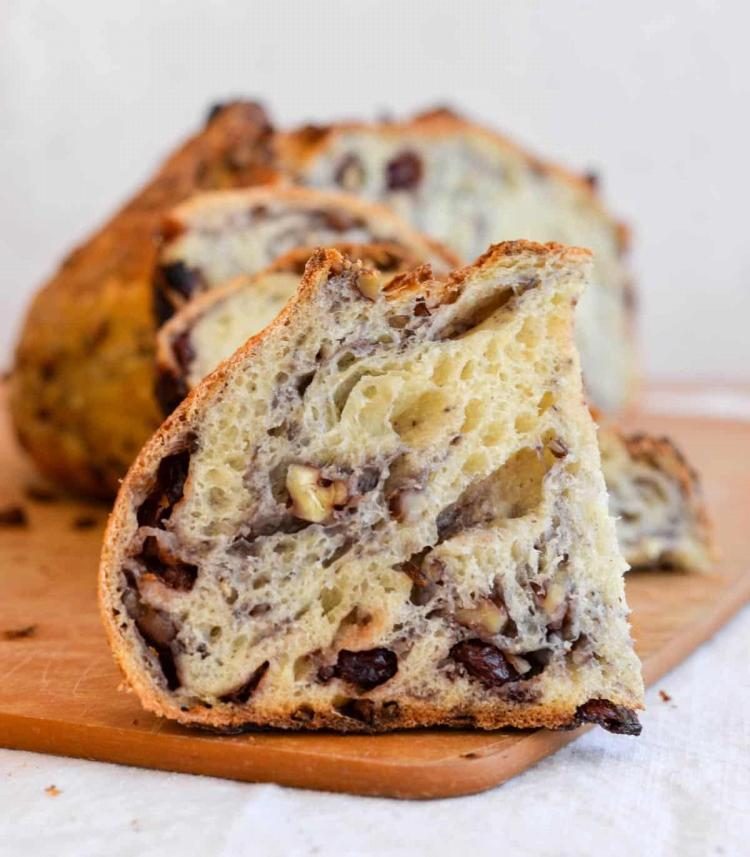
Cranberry Pecan Sourdough Bread
An artisan sourdough loaf made with a levain and studded with roughly chopped pecans and craisins, cold-fermented overnight and baked in a preheated Dutch oven.
Nutrition
Ingredients
| 35 grams | ripe sourdough starter, about 2 Tablespoons (Levain) |
| 35 grams | all purpose flour, about 1/4 cup (Levain) |
| 35 grams | water, about 2 Tablespoons (Levain) |
| 100 grams | ripe levain, scant 1/2 cup |
| 375 grams | water total, 25 grams reserved for after fermentolyse, about 1 1/2 cups water (plus 1 Tablespoon reserved for after fermentolyse) |
| 500 grams | white bread flour, about 3 3/4 cups |
| 10 grams | salt, reserved for after fermentolyse, about 1.5 teaspoons |
| 75 grams | pecans, roughly chopped, about 2/3 cup, reserved |
| 90 grams | craisins (dried cranberries), about 2/3 cup, reserved |
Instructions
SCHEDULE Day 1 7:00 AM – 10:30 AM: Mix Levain, let rest at 78ºF Temperature 10:30 AM – 11:00 AM: Fermentolyse 11:00 AM: Add salt and water 11:30 AM: Stretch and Fold #1 12:00 PM: Stretch and Fold #2 (Add pecans & craisins) 12:30 PM: Stretch and Fold #3 12:30 PM – 2:30 PM: Finish Bulk Fermentation 2:30 – 3:00 PM: Pre-shape dough / bench rest 3:00 PM: Shape; Begin Cold Fermentation Day 2 – Bake 8:00 AM: Pre-heat Dutch Oven 8:30 AM: Bake
DETAILS FOR FOLDING AND SHAPING: https://amybakesbread.com/cranberry-pecan-artisan-sourdough-bread/
INSTRUCTIONS Day 1: Levain / Mix / Bulk Fermentation / Shape / Cold Fermentation
Levain: Mix together 35 grams ripe sourdough starter, 35 grams all-purpose or bread flour and 35 grams water. Set aside to ripen for 3-4 hours, keeping the temperature at 78ºF. Levain is ready when it has doubled in size, is very bubbly, smells milky sweet, and is just about to fall. Note: Equal weights of ripe, bubbly, active sourdough starter can be substituted for levain in this recipe.
Fermentolyse: Once the levain is peaked and active, mix 100 grams levain with 350 grams of water in a large bowl. Warm the water if the ingredients are too cold and cool the water if the ingredients are too warm. Add the 500 grams bread flour to the bowl and mix until incorporated and a shaggy dough forms. Let rest for 30 minutes.
Mixing: After 30 minutes, add the reserved salt and the remaining 25 grams of water. Combine using your hands by squeezing the dough between your fingers, pinching chunks of dough, and reincorporating together. The dough will break apart and then reform in the bowl through this process. Pick up one side of the dough and fold it over on itself. The dough will be sticky. Wet your hands as needed and continue to work with the dough, slapping it against the side of the bowl and stretching it back until all the salt and water have been incorporated and the dough is cohesive and strong.
Bulk Fermentation: Perform 3 sets of "stretch and folds," adding the craisins and pecans in during the second set. To “stretch and fold,” wet your hand (so it doesn’t stick to the dough). Reach down to the bottom of the bowl of dough and pull the dough up and over the top of the dough. Turn the bowl 1/4 turn and repeat the stretch and fold. Turn another quarter turn and repeat. Perform one more 1/4 turn with stretching and folding the dough. Cover and set aside for 30 minutes. Watch a video of the process here.
Stretch and Fold #1: 30 minutes later, stretch and fold the dough (1 hour into bulk fermentation). Stretch and Fold #2: 30 minutes later, add craisins and pecans. Stretch and fold again, beginning to incorporate the craisins and pecans into the dough. Stretch and Fold #3: 30 minutes later, stretch and fold again. The craisins and pecans will continue dispersing throughout the dough. You should notice the dough feeling more cohesive and strong during this stretch and fold, and not needing very much folding to come together. If your dough still feels loose, add in another couple of stretch and folds to help strengthen and tighten the gluten strands.
Bulk Fermentation Continued: Let the dough rest in a warm place, for the rest of bulk fermentation, about 2-3 hours at 78ºF. During this time the dough will puff up about 30-40%, become more aerated, start to pull away from the edges of the bowl and have a few scattered bubbles around the edges/top of the dough. If your dough is not showing these signs, make sure it's warm enough and give it another half an hour or so until it is showing signs that it's ready to shape.
Pre-Shape: Tip the bowl upside down, allowing the dough to fall onto a clean counter surface. Be gentle to avoid cutting and degassing the dough as much as possible. Use damp hands and push the bench knife under the dough while using your free hand to tuck the dough under itself. Repeat this process going around in a circle until you have a tight ball of dough.
Bench Rest: Let the dough rest uncovered for about 30 minutes at room temperature. The dough will flatten a bit during this period of time.
Prepare Bowl: Prepare a bowl or banneton with a liner or sprinkle with rice flour.
Shaping: After the dough has rested for about 30 minutes it is time to shape the bread into a round. Sprinkle flour on top of the dough. Using the bench knife, lift the dough up off the counter and place it on top of the countertop–floured side down. This ensures that the flour is staying mainly on the outside of the dough. Going around in a circle, pull the dough sideways towards you and then fold up to the top of the round. Move 90 degrees and repeat the same process pulling the dough sideways and then folding up to the top. As you continue this process around the dough, increase the tension as you pull. If a craisin or pecan pops out, remove it from the loaf or stick it on the bottom of the dough. Gather the bread into a circle and use a bench knife to lift the bread and place into your lined bowl. Watch the process here.
Stitch the Dough: Let the dough rest and the gluten relax for about 5 minutes before stitching up the dough if desired. This adds a last little bit of tension, but is completely optional.
Cold Fermentation: Cover the dough with a shower cap, plastic wrap or a reusable cover and store the dough in the refrigerator overnight for 12-18 hours. Alternatively you can let your dough rise outside the fridge for another 2-3 hours, keeping the dough at that 78ºF temperature, and then bake your loaves the same day.
Day 2: Score and Bake
Pre-heat the Oven: Put a dutch oven (top and all) into the oven and preheat to 500ºF. Allow the dutch oven to heat for about 30 minutes at 500ºF.
Scoring: Once preheated for 30 minutes, pull the loaf out of the refrigerator. Remove the plastic wrap (this is easy to do straight out of the refrigerator if the dough is chilled – not easy if the dough warms up) and place a piece of parchment paper on top of the bread dough. Flip the dough over so that the dough is now sitting on the parchment paper. Take off the bowl/banneton and kitchen towel. Smooth the flour over the top of the dough (add a little extra for more contrast if desired). Use a very sharp knife or bread lame to score the dough. Bread with inclusions typically does not score quite as well as bread without. This is not a loaf for intricate scoring. One large slash, about 1 inch deep is sufficient.
Bake: Carefully remove the dutch oven from the 500ºF oven with hot pads. Take the top off and place your bread into the dutch oven (including parchment paper – this helps with the transfer). Be very careful not to touch the sides of the dutch oven. Put your hot pads back on before you pick up the lid of the dutch oven and place it on top of the bread. Put the whole dutch oven back into your oven. Lower the temperature to 450ºF and bake for 25 minutes. Once 25 minutes are up, take the top off the dutch oven and continue baking for 20 minutes until the bread is a crackly deep brown.
Remove the bread to a wire cooling rack. Cool and enjoy!
NOTES This recipe is based on my classic sourdough bread recipe. I often substitute 50 grams whole wheat flour for 50 grams of bread flour in this recipe with good results. It improves the flavor and speeds up fermentation just a bit. Active Sourdough Starter: If you prefer to use ripe, bubbly, active sourdough starter, it can be substituted for levain in this recipe. Same Day Baking: If you want to bake this recipe the same day and skip the cold fermentation, let the dough rise in the bannetons or bowls on the counter. Do your best to keep the dough warm, in the 78-80ºF range, and allow it to rise for 2-3 more hours. Once the dough has risen another 30-40%, pre-heat the Dutch oven and bake the loaves according to recipe directions. Baking in a Loaf Pan: You can also bake this bread in a loaf pan. Find all the details here.
NUTRITION (per serving) Calories: 178kcal, Carbohydrates: 31g, Protein: 5g, Fat: 4g, Saturated Fat: 0.4g, Polyunsaturated Fat: 1g, Monounsaturated Fat: 2g, Sodium: 245mg, Potassium: 56mg, Fiber: 2g, Sugar: 4g, Vitamin A: 3IU, Vitamin C: 0.1mg, Calcium: 10mg, Iron: 1mg