
Delicate Taro Puff Dumplings (Wu Gok)
A special dim sum dumpling (yu jiao / 芋角) whose wrapper is made with taro. After deep-frying, the outside puffs into a beautiful, delicate honeycomb crust while the middle stays soft and creamy – like a crispy, flaky mashed potato stuffed with a savory filling. The recipe is complicated and challenging, so the author includes many details and tips. Safety note: most edible taro contains oxalic acid crystals that can cause itchy skin for some; the crystals dissolve once cooked, but if you have never handled taro it is better to wear gloves.
Ingredients
| 400 g | taro | |
| 200 g | water | |
| 1/2 tsp | 2.5 ml | salt |
| 1 Tbsp | 15 ml | sugar |
| 160 g | wheat starch | |
| 130 g | pork lard | |
| 1 Tbsp | 15 ml | cooking oil |
| 113 g | ground pork | |
| 40 g | Cantonese sausage | |
| 9 g | dried shiitake mushrooms (about 3) | |
| 60 g | carrot | |
| 113 g | shrimp | |
| 1 Tbsp | 15 ml | Chinese cooking wine |
| 1/2 tsp | 2.5 ml | ground white pepper |
| 2 tsp | 10 ml | oyster sauce |
| 2.5 tsp | 13 ml | soy sauce |
| 1 tsp | 5 ml | dark soy sauce |
| 2.5 tsp | 13 ml | cornstarch |
| 2.5 Tbsp | 38 ml | mushroom soaking liquid |
| 1/4 cup | 60 ml | scallions |
| 2-3 cups | 480–720 ml | oil to deep-fry the dumplings |
Instructions
Choose the right taro: Dasheen (C. esculenta var. esculenta) is large, dense, and high in starch – excellent here; avoid the low-starch end section near the stems. Eddoe (var. antiquorum) is smaller with lower starch and can be used but yields less crispy dumplings.
Make the dough: 1) Peel the taro, slice into 1/4-inch slabs, stack, and cut into strips. 2) Put the taro strips, salt, sugar, and water in a saucepan, cover, bring to a boil over medium heat, then reduce to low and simmer 10 minutes. 3) Remove from the stove, add the wheat starch immediately, and use a potato masher to mash the taro and combine until crumbly. (Corn/potato/tapioca starch can replace, but you'll need to test the water-starch ratio and frying temperature.) 4) Add the taro-starch mixture to a food processor and mix on the lowest speed until a rough dough forms (in 2 batches if small). 5) Add the pork lard and mix at low speed until the oil is well absorbed (butter can replace lard). 6) You want a non-stick, soft, super-oily dough; seal in a container and chill at least 24 hours. Chef's secret: the starch needs a long time to fully retrograde or the dumplings won't puff perfectly.
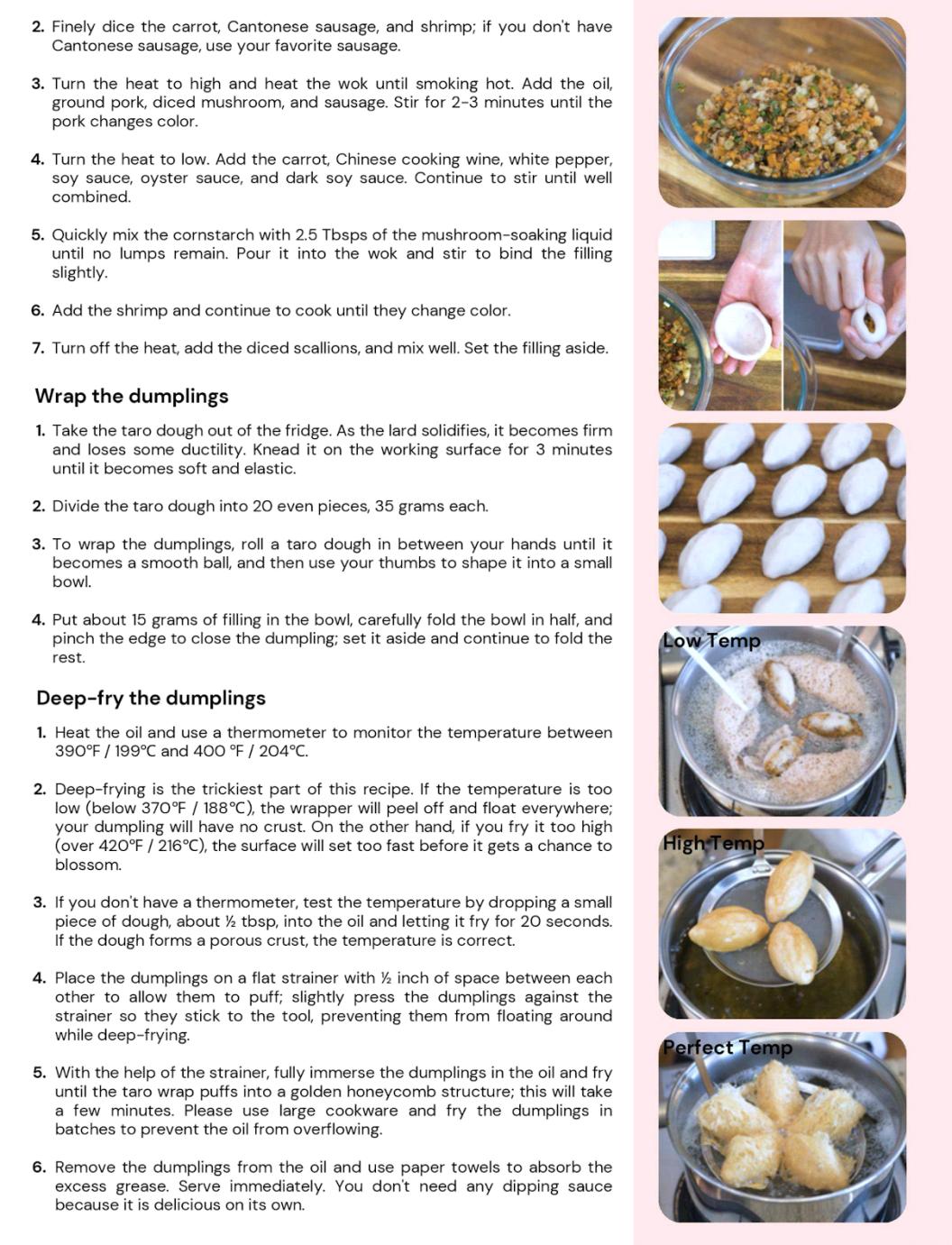
Make the filling: 1) Soak the dried shiitake 2 hours in advance, dice finely, and reserve the soaking liquid. 2) Finely dice the carrot, Cantonese sausage, and shrimp (use any sausage if needed). 3) Turn heat to high and heat the wok until smoking; add oil, ground pork, diced mushroom, and sausage and stir 2-3 minutes until the pork changes color. 4) Turn heat to low; add carrot, cooking wine, white pepper, soy sauce, oyster sauce, and dark soy sauce and stir until combined. 5) Mix the cornstarch with 2.5 Tbsp mushroom soaking liquid until smooth, pour in, and stir to bind the filling slightly. 6) Add the shrimp and cook until they change color. 7) Turn off heat, add diced scallions, mix, and set aside.
Wrap: 1) Take the taro dough out of the fridge; as the lard solidifies it becomes firm, so knead 3 minutes until soft and elastic. 2) Divide into 20 even pieces (35g each). 3) Roll a piece into a smooth ball, then use your thumbs to shape into a small bowl. 4) Put about 15g filling in the bowl, fold in half, pinch the edge to close, and continue with the rest.
Deep-fry: 1) Heat the oil to between 390F/199C and 400F/204C. 2) Frying is the trickiest step: too low (below 370F/188C) the wrapper peels off and floats with no crust; too high (over 420F/216C) the surface sets before it can blossom. 3) No thermometer? Drop a 1/2 Tbsp piece of dough and let it fry 20 seconds – if it forms a porous crust, the temperature is right. 4) Place the dumplings on a flat strainer with 1/2 inch between them and lightly press against the strainer so they don't float. 5) Fully immerse and fry until the taro wrap puffs into a golden honeycomb, a few minutes; use large cookware and fry in batches to prevent overflow. 6) Remove, blot excess grease on paper towels, and serve immediately – no dipping sauce needed, it's delicious on its own.