How long should we cook a certain thing
Food-science reference on cooking times/temperatures, including a turkey roasting table and the effect of acids and oven temperature on cook time.
Ingredients
Instructions
Because the effect of acids is to destabilize protein structure generally, even slightly acidified proteins are also more sensitive to temperature, often cooking at lower temperatures than they would in neutral conditions. An example of this can be found in poached egg recipes like the one that we saw in the previous video.
HOW LONG TO COOK A TURKEY
TURKEY Cooking Times and Temperatures — Turkey Oven Roasted at 325°F (Approximate Cooking Time — Unstuffed / Stuffed):
- Turkey (whole), 8–12 lbs: 2 3/4 – 3 hours / 3 – 3 1/2 hours
- Turkey (whole), 12–14 lbs: 3 – 3 3/4 hours / 3 1/2 – 4 hours
- Turkey (whole), 14–18 lbs: 3 3/4 – 4 1/4 hours / 4 – 4 1/4 hours
- Turkey (whole), 18–20 lbs: 4 1/4 – 4 1/2 hours / 4 1/4 – 4 3/4 hours
- Turkey (whole), 20–24 lbs: 4 1/2 – 5 hours / 4 3/4 – 5 1/2 hours
- Breast (half), 2–3 lbs: 50 – 60 minutes
- Breast (whole), 4–6 lbs: 1 1/2 – 1 1/4 hours
- Breast (whole), 6–8 lbs: 2 1/4 – 3 1/4 hours
- Drumsticks, 3/4 – 1 lb: 2 – 2 1/4 hours
- Thighs, 3/4 – 1 lb: 1 3/4 – 2 hours
- Wings, 6–8 oz: 1 3/4 – 2 1/4 hours
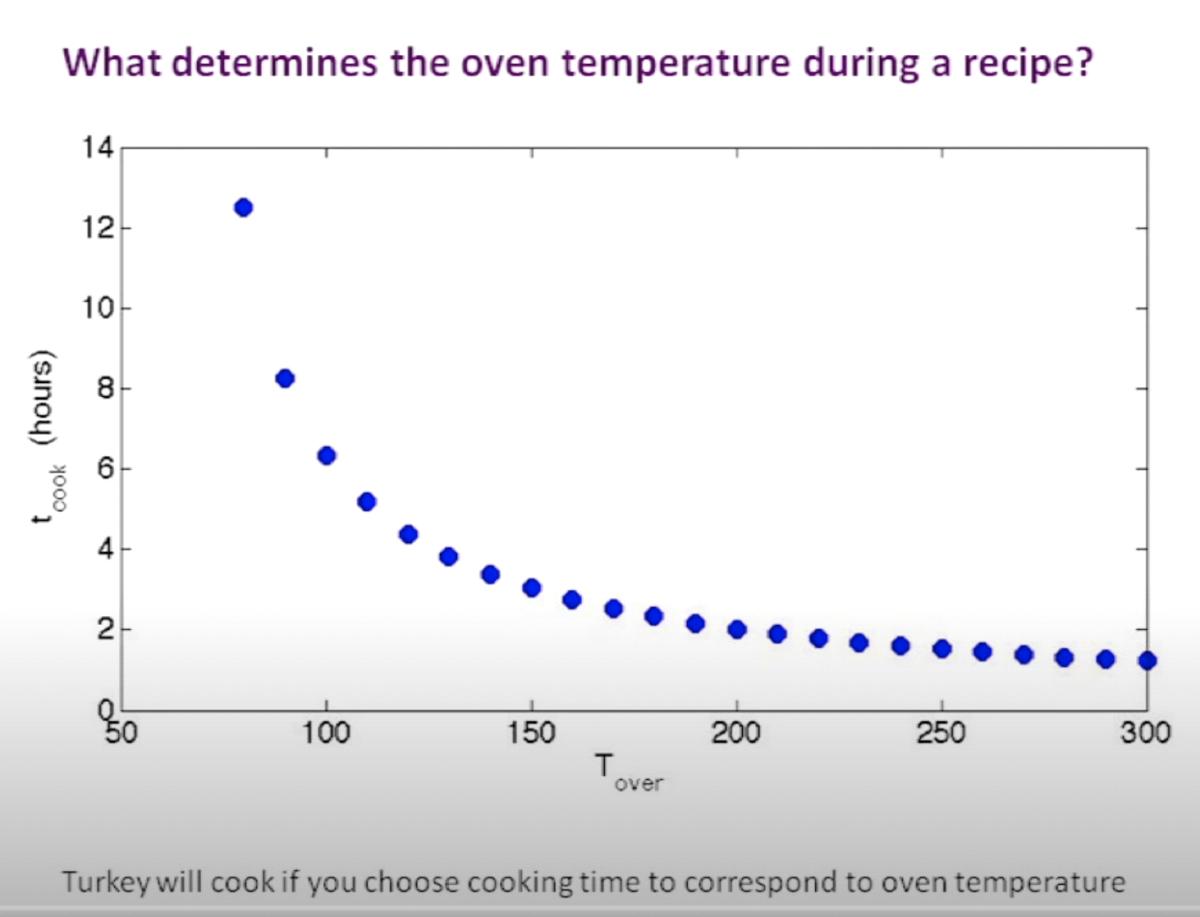
Cook-time formula: t_cook = (1/π) · (9.6 cm)² / (1.4 × 10⁻³ cm²/sec) · log((T_oven − T_internal)/(T_oven − T_target)) = 2.7 hours, with T_target = 73 °C (USDA) and T_oven = 163 °C.
What determines the oven temperature during a recipe? (graph of t_cook in hours vs T_oven, 50–300): a turkey will cook if you choose the cooking time to correspond to the oven temperature.
Despite the table above, the best temperature is the one in the recipe above it, because it takes into account the thermal reactions of many other things, not just how quickly the internal temperature will be reached.
Browning & Oxidations | Lecture 9 (2010) — Some Rules of Thumb:
- Maillard reactions tend to occur above 120 °C / 250 °F.
- Reactions are accelerated in basic (pH>7) conditions. Baking soda accelerates browning reactions!
Flavors produced by Maillard Reactions (from H. McGee, pg 779):
- Savory (peptides, amino acids)
- Floral (oxazoles)
- Onions, meatiness (sulfur compounds)
- Green vegetables (pyridines, pyrazines)
- Chocolate (pyrazines)
- Potato, earthy (pyrazines)
Major issue w/ Maillard Reactions: the temperature of the reaction is above the boiling point of water. But food is predominantly made of water! Thus it must evaporate off the water before this reaction can take place. This is the real point of frying — the boiling temperature of oil is well above the temperature for Maillard!
To turn ethanol into ice, it must be frozen to −114 °C. Liquid nitrogen is liquid only between −195 and −210.
Melting ranges of fats (the melting behavior depends on the composition):
- Coconut oil solidifies below 24 °C.
- Olive oil at −6.
- Coconut butter melts between 27 and 35 °C.