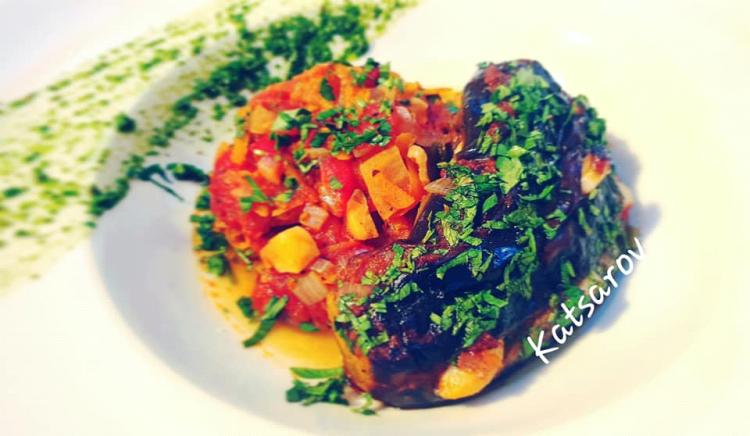
Imam Bayildi from the village of Trud
"The fainted imam" is a Lenten dish typical of the Balkan region, with roots in Turkish cuisine. It is prepared in: Turkey (of course), Bulgaria, North Macedonia, Greece, Albania, Armenia, Georgia, Iran, the whole Middle East. Even in the Italian "Parmigiana di melanzane" (fried eggplants used as "sheets" for lasagna and assembled with tomato sauce, mozzarella and parmesan) one can find traces of Imam bayildi. However, I will not write an essay about the culinary history, roots and incarnations of this dish, but will present it to you the way my grandmother Tsvetana from the Plovdiv village of Trud used to make it.
Ingredients
| — | Патладжан — 3 броя (средни) / Eggplant — 3 medium (1 per person) |
| — | Чесън — глави / Garlic — heads |
| — | Лук — глави (средни) / Onion — medium heads (1 per eggplant) |
| — | Моркови — броя (средни) / Carrots — medium (1 per eggplant) |
| — | Люта чушка — по желание / Hot pepper — optional |
| — | Домати 800 гр. / Tomatoes 800 g (1 large per eggplant) |
| — | Бамя — гр. (по 3-4 шушулки на човек) / Okra — g (3-4 pods per person) |
| — | Орехи — гр. (по около 30 гр. на патладжан) / Walnuts — g (about 30 g per eggplant) |
| — | Олио много / Plenty of cooking oil |
| — | Червено вино — мл / Red wine — ml |
| — | Захар — суп.лъж. / Sugar — tablespoons |
| — | Сол на вкус / Salt to taste |
| — | Дафинов лист — брой / Bay leaf — piece |
| — | Червен пипер — суп.лъж. / Red (paprika) pepper — tablespoons |
| — | Чубрица — каф.лъж. / Savory (chubritsa) — teaspoons |
| — | Магданоз — връзка / Parsley — a bunch |
Instructions
PRODUCTS: My grandmother used measurements only for the sweets, and cooked everything else "by eye" and feeling, and it was hard for her to simply write down a recipe for someone who asked. To learn, you had to watch. I remember that whenever someone asked for a recipe she would invite them over and show them. Learning through shared experience and direct living! So, depending on how many people you are cooking for, the set proportion "by eye" is: 1 eggplant per person; for each eggplant 1 medium carrot, 1 large tomato, 1 medium onion head, about 30 g walnuts. Here I give the products for three, as much as I cooked. Before we begin - always choose firm eggplants with shiny skin and fresh stems.
PREPARATION:
- Wash and peel the eggplants. You may peel them in stripes and keep part of the skin (this holds the shape of the eggplants and keeps them from falling apart). If the skin is tough, of course you can peel it off entirely.
- Make deep cuts with a knife in several places along the eggplants.
- Wash and clean the caps of the okra and put it in a bowl with salted, cold water. (*The dish in the photo has NO okra, because I did not find any at the market.)
- Salt the eggplants and leave them to release their bitterness for 20 min.
- Meanwhile the great garlic peeling begins. Halve each clove with a knife into smaller pieces if it is too big. We will lard the eggplant with the garlic in the cuts we made. In the TRUD recipe for imam bayildi, the eggplant is stuffed only with garlic. The better you lard the eggplant, the more garlic, the tastier. Still, be careful not to split the eggplant with the garlic.
- Prepare the onion by peeling and chopping it however you like – coarser or finer. If you want to give a European look to this Oriental dish, know that it does not matter at all how coarsely you cut, because afterwards you will puree all the vegetables, except the eggplant.
- Peel the carrots and grate them on the coarse grater.
- Peel the tomatoes (make a light cut, then dip them in boiling water for 20 seconds and immediately shock them in cold water afterwards) and cut them into small to medium pieces. You may also not peel them but grate them on the coarse grater and thus remove the skin. The completely lazy option is to use canned tomatoes or tomato puree (of which I am not too much of a fan, but...).
- Chop the hot pepper finely or, if you want it less spicy, just split it lightly so it releases a little fire into the dish, and later you will remove it.
- Chop the parsley (stems separately and leaves separately; put the leaves in a small bowl, cover with foil and store in the fridge, because we will use them only at the end of the recipe).
- Crush the walnuts finely, but not into flour, because they should still be noticeable.
- The eggplants have released their bitterness, so I wash them under running water and dry them well with a kitchen towel or paper, because we are about to fry, and a wet eggplant in hot fat turns the kitchen into a battle scene. Drain and rinse the okra again.
- Put one clove (or part of a clove) of garlic into each cut we made earlier in the eggplant. This is the first secret for an incredible taste that I reveal to you – larding with garlic.
- In a pot we put fat so that we have an oil bath one finger thick. Once the fat is well heated, we put the eggplants to fry, turning them periodically so they brown on all sides and acquire a golden-brown tan in places. This is not the only heat treatment for the eggplants, so we do NOT fry them until done, but only until they get a tan here and there. That tan, however, is very important, because part of the magical taste of the dish is due to it – the reason the imam fainted. When the eggplants get the said tan on all sides, we remove them onto kitchen paper or a rack, or into a tilted vessel, so the excess fat drains off.
- Into the same fat in which we fried the eggplants we must add the onion. That is how grandma did it, that is how I do it and the taste is incredible, but it is not tolerated by people with more sensitive stomachs. So decide for yourself whether you want to remove this fat and sauté the onion in fresh fat. We add the onion, immediately sprinkle with 1 tablespoon of sugar and sauté. This is the second secret I reveal to you – this is the moment for the sugar, with the onion.
- After we have sautéed the onion for a few minutes, it is time to add the hot pepper (may be omitted), the carrots, the parsley stems, and the sautéing continues for a few minutes, after which we also add the walnuts.
- When the vegetables soften, add the red (paprika) pepper (you may add a little more than the given amount, depending on how much you like it), stir well and immediately add the wine, so the pepper does not burn. If you want a slightly more rustic smoky aroma in city conditions – you know how to do it with a little smoked paprika.
- Immediately after the wine we add the tomatoes, the okra and the spices (bay leaf and savory) and leave it to boil. When that happens we season with salt to taste. I emphasize that we do NOT add extra water to the dish. The only liquid comes from the wine and the water in the tomatoes.
- In a clay pot or another ceramic baking vessel, or an oven glass dish, put the tomato mixture and place the fried eggplants on top of it. Cover or wrap with aluminium foil and place in a COLD oven. Especially for clay vessels – nothing shortens their life like abrupt temperature changes. That is why we put the vessel in a cold oven and temper SLOWLY. This means we set the temperature to 100 for 15 minutes, then increase to 150-170 degrees and forget about the dish for 1 hour.
- After one hour of baking we remove the lid of the vessel, lower the temperature to 130-140 degrees and let the liquid evaporate so the dish is left only in fat.
- We do not take out the vessel immediately (especially if it is clay), but leave it to cool slowly in the oven.
- When we take it out – we sprinkle with the finely chopped parsley leaves and serve in individual portions. A piece of good cheese may also be served alongside the dish.
ADDITIONAL NOTES: If you do not like okra – you may skip it. The same applies to the hot pepper. It will be hard to skip the eggplants and the garlic. You may avoid frying and instead grill the eggplants sliced into slices, then arrange eggplants, sauce, eggplants (similar to melanzane). This can also happen in individual dishes/pots. And since we drifted toward Italy we have many options, for example just before you turn off the oven, sprinkle with parmesan or put mozzarella to melt. Kashkaval is also an option and for the finish we sprinkle with breadcrumbs for a crispy crust. In this case you may also drift toward basil. For Bulgarians abroad, however, who miss the savory (chubritsa), perhaps dried oregano comes closest to it in taste. There is a variant: after the dish is ready, separate the eggplants (and okra) and puree the rest. Serve tomato sauce with eggplant and cubes of cheese with herb (parsley) pesto or simply rolled in finely chopped fresh herbs, wild onion, ramson, etc. A cliché in white, green and red. An idea is to replace the walnuts with peeled and finely chopped almonds – the taste is inimitable. If you want to change the rustic recipe here is another variant: we peel the eggplants in stripes, but do not lard them with garlic. We fry them a bit longer and then leave them to drain. Carefully with a small knife and spoon we shape boats, scooping out part of the eggplant's flesh. This "flesh" we mix with separately fried onion, garlic, carrot, tomatoes, walnuts/almonds, spices (all cut very finely). With this filling we stuff the boats, put them in an uncovered pot, with fat and a little wine, and they bake until the eggplants are left only in fat. Despite my creative and experimental spirit, however, I always return to the classic, my personal classic – the tastes I grew up with and which formed me as a person, because food is more than a bloated belly and an insulin cascade. Every aroma is a memory! Thank you! Dr. Katsarov (psychiatrist and psychotherapist)