
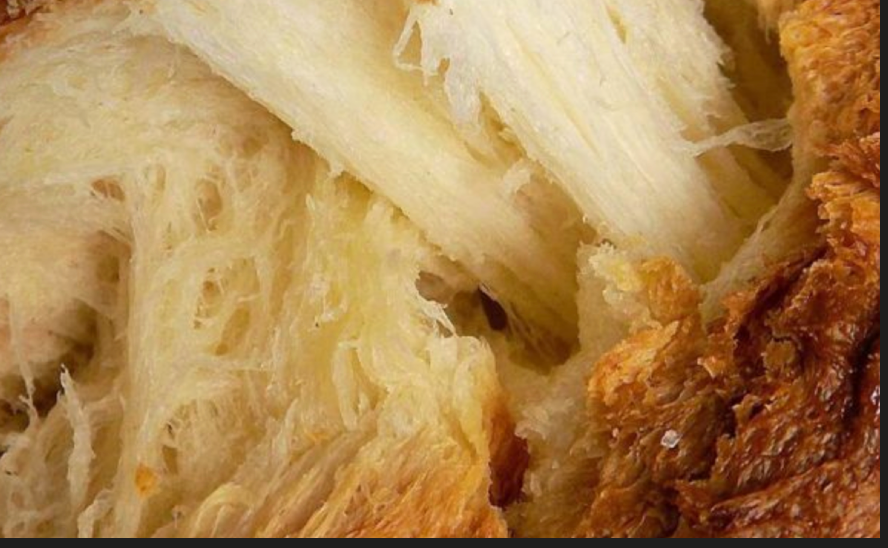
Stringy Kozunak (Bulgarian Easter Bread) — Bread Machine
A fluffy, aromatic Bulgarian Easter sweet bread that pulls apart into fine strings ('na konci'). The dough is kneaded and proofed in a bread machine, then shaped and baked. The recipe nails the product-and-temperature ratios for a perfect crumb.
⏱️ Prep: 60 min🍳 Cook: 30 min🍽️ Makes 17
Nutrition
per 1 slice (~60 g)225
Calories
5g
Protein
37g
Carbs
6g
Fat
Ingredients
| 550 g | Flour for kozunak, strong & fine, sifted 3× (W350, protein ≥12) | |
| 200 ml | Fresh (or coconut) milk, lukewarm ~35°C (+1 Tbsp for brushing) | |
| 130–150 g | Sugar (dissolved in the milk) | |
| 15–20 g | Fresh yeast (or 7 g dry) | |
| 3 + 1 white | Eggs, room temperature (+1 white for brushing) | |
| 30 g | Butter, melted (author uses coconut) | |
| 20 g | Lard, melted | |
| 30 ml | Oil | |
| 2–3 Tbsp | 30–45 ml | Liquid sweetener |
| 1 Tbsp | 15 ml | Rakia (fruit brandy) |
| 2 | Vanilla | |
| 1 ampoule | Lemon essence | |
| — | Zest of 1 lemon | |
| — | A few drops of rum or essence |
Instructions
- Dissolve the sugar in the lukewarm milk (~35°C). Add 2 Tbsp of the sifted flour to part of it and stir to a slurry, then crumble in the fresh yeast and leave to activate (get foamy).
- Meanwhile, lightly beat the 3 room-temperature eggs, add the rest of the milk and half of the melted fat (the blend of the three fats described above).
- Add the essences, rakia, liquid sweetener, vanilla, and the activated yeast. Stir.
- Set aside 100 g of the flour. Add the rest to the wet ingredients a spoon at a time, then pour the mixture into the bread machine.
- Depending on your machine: if it has a short kneading program (e.g. for pasta), run it; if not, run the normal knead-and-proof program but be ready to stop and restart it after 15 min.
- After the first 15 min, restart the pasta program (or the main one) and start adding the reserved flour one spoon at a time, waiting for each spoon to be absorbed before the next.
- After another 15 min, restart the main knead-and-proof program (the author's is 1 h 15 min) and, while it runs, add the reserved fat one spoon at a time, again waiting for each to be absorbed.
- Let the program finish — the dough should have doubled. Warm the room (~30°C).
- Turn the dough onto an oiled surface and form ropes; braid as you like and place in an oiled 25 cm round tin. It rises a lot into a soft kozunak, so keep the braid loose with ~1 cm gaps.
- Let it proof a second time in the oven at 45–50°C for between half an hour and 1.5 hours (depends on the sugar and yeast — more sugar proofs slower).
- Move it to a warm room and heat the oven to 170°C (or 190°C without a fan).
- Brush the kozunak with the reserved beaten egg white and a spoon of fresh milk. Optionally sprinkle with heat-stable sugar, or with damp hands sprinkle regular sugar.
- Bake at 150°C fan (or 160°C without) for about 30 min.
- When baked, open the oven but let it cool inside for a few minutes — don't pull it straight out into the cold.
- Brush with a cold sugar syrup made from equal parts water and sugar.
Tips
- All ingredients at room temperature.
- Use fine flour (for banitsa/kozunak) sifted 3× to incorporate air.
- Rakia feeds the yeast — don't skip it.
- Too much sugar weighs the dough down; ideal is up to 250 g sugar per 1 kg flour. If not sweet enough, add liquid sweetener. Dissolve sugar in the milk, don't add it as crystals.
- Kozunak is best with 3 kinds of fat (here 90 g total). Add half at the start and the second half spoon by spoon after the dough comes together (~30 min in).
- No bread machine has a kozunak program, so you'll stop/restart the dough program 3 times, or run 2 pasta programs and proof in the (warm!) room, then shape warm and proof again.
- Put it into a warm oven and immediately lower the heat — kozunak bakes low and slow. For 1000 g flour: 190°C reduced to 160°C; for 550 g: 170°C reduced to 150°C.
- Bake with steam, or with a few bowls of water around the tin.
- Dough under 1 kg bakes ~30 min; 1 kg ~45 min; 1.5 kg ~1 h; 2 kg ~1.5 h.