
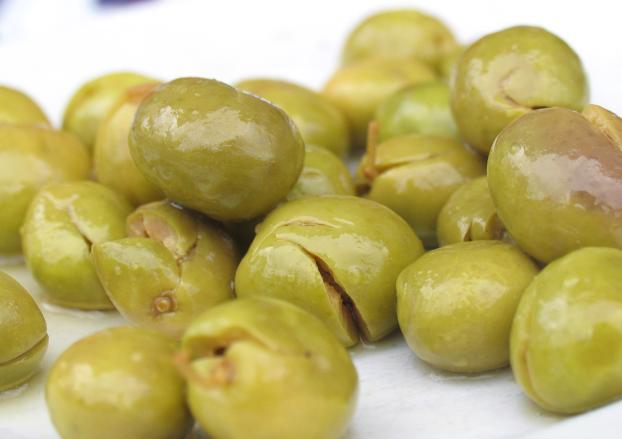
Olivas partidas - Spanish split olives
Traditional Spanish-style cracked (split) green olives cured in herb brine. From a Catalan eco-farm blog (Delta de l'Ebre).
Ingredients
| — | green olives |
| 70 g | sea salt |
| 1 liter | cold filtered or rain water |
| 4 | green hot peppers |
| 1 bunch | savory, thyme or finely chopped fennel sticks |
| — | carob leaves border |
| 4 | lemon leaves (optional) |
| 4 | bay leaves (optional) |
Instructions
Ingredients:
- green olives
- 70 g sea salt
- 1 liter of cold filtered or rain water
- 4 green hot peppers
- 1 bunch savory, thyme or finely chopped fennel sticks
- carob leaves border
- 4 lemon leaves (optional)
- 4 bay leaves (optional)
- Wash the olives with cold water to clean them of dust or dirt and let them drain.
- Find a suitable place to split the olives; when splitting them they splash liquid around, so wear old clothes or a good apron. You will also need a piece of flat wood (or a tree trunk or an old, well-cleaned table) and a flat stone the size of your fist or a wooden hammer. Take olives one by one, put them on the wood and give a soft, dry tap to split each olive without breaking the stone or destroying them (otherwise they will not work out). Put the split olives in a large bowl and continue until all are done.
- Decide whether to prepare the olives for a year or just a few weeks:
- To store them for months without eating them beforehand, fill them directly with their grout (the liquid that comes out when you split them). They will lose their bitterness over the months in the brine.
- To eat them after a couple of weeks, soak them in rainwater or filtered water for a week, renewing the water every day, which removes the bitterness faster.
- To pot them, put a liter or more of water (depending on the amount of olives) in a large bowl and add 70 g of sea salt per liter, stirring constantly until fully dissolved. Use ceramic, glass or plastic containers to soak/store the olives - never metal, as it would spoil them.
- Cut the savory and fennel sprigs to 4-5 cm. Cut the hot peppers into pieces. Wash the carob leaves, and the lemon and bay leaves if using. (Carob leaves do not add flavor but are traditionally added because they are said to prevent the olives from softening.)
- Fill a third of the bottle with olives, add a few sprigs of savory, a piece of hot pepper, some carob leaves, a lemon and bay leaf and some fennel sticks. Continue layering olives, savory, pepper, fennel leaves and stems until the carafe is full, ending with a layer of savory and fennel. It is important to cover the top with a layer of herbs and leaves so the olives stay under the brine - if they stick out they blacken, spoil and can contaminate the whole carafe.
- With a wooden or plastic ladle (never metal), fill the pot with the brine. Close the bottle and store in a cool, dry place out of the light.
- After the two weeks or several months (depending on the debittering process chosen), remove them from the bottle to eat. They can be eaten directly as seasoned by the herbs during curing, or reseasoned. A trick: bathe them in good organic extra virgin olive oil before serving. Invent your own final dressings, mixing different herbs (thyme, rosemary, mint, sage, lemon verbena...), spices (garlic, cloves, pepper, paprika, curry...) and even fruits (orange, lemon...) in the oil bath. Take them out of the brine and enjoy!
Tips from the farm (blog Q&A):
- Fewer water changes keep the olives crisper; too many days of washing make them soft. For whole olives 3-4 days of debittering (changing water daily) is enough, and about 2 days for split batches.
- Split olives cure faster than whole ones (2-3 weeks vs at least a month) because the brine soaks in more easily.
- Olives can stay in brine for months, even over a year, if stored in closed 6-liter bottles in a dry place out of the light, opening them as needed.
- During the first days of curing, leave the caps loose so the gas produced can escape without bursting the cap, and top up the brine (about once a day) until the level stabilizes.
- Adding carob leaves when brining helps prevent the olives from going soft.