
Pepparkakor - Swedish Christmas Biscuits
Thin, crisp Swedish spiced Christmas biscuits decorated with royal icing; kept in a tin with an apple so they soften over time.
Ingredients
| 1 1/4 cups | 300 ml | sugar |
| 1 cup | 240 ml | honey |
| 114 g | butter | |
| 250 ml | liquid heavy cream | |
| 1 tbsp each | ground ginger, cardamom and cloves (1 tbsp each) | |
| 1/2 tsp | 2.5 ml | nutmeg |
| 1 tsp | 5 ml | cinnamon |
| 1 cup | 240 ml | ground walnuts |
| 5 cups | 1.2 l | white flour |
| 10 g | baking powder | |
| 1 | zest of 1 lemon and 1 orange |
Instructions
Heat the melted butter, sugar and honey over low heat until you get a homogeneous mixture. Cool it, then add the cream, spices and walnuts and beat everything until it turns pale. Add the flour with the baking powder, keeping a little aside for rolling out. Knead a smooth dough, put it in a plastic bag and leave it to rest in a cool place overnight. Roll the dough out very thinly on a floured surface and cut into various shapes. Bake the biscuits on a buttered tray or on baking paper for no more than 5 minutes at 200°C. Cool slightly and lift them off the tray. Decorate the biscuits with royal icing, or sprinkle them with various cookie decorations or melted chocolate. Arrange them in tin boxes, placing one apple cut into four in each box. They are ready to eat after a few days, when they soften (from the apples). It is good to make them at the beginning of December, because the longer they stand, the better they get.
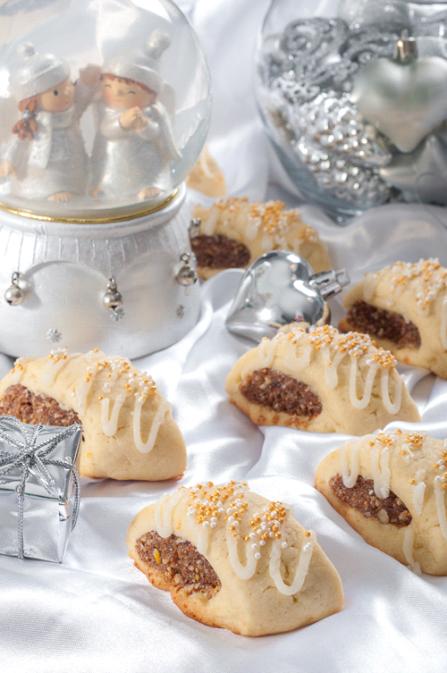
--- BONUS RECIPE ON THESE PAGES: Cucidati – Sicilian Christmas cookies (Кучидати) --- The recipe is based on ideas from epicurious.com and tasteofhome.com. It is convenient because the two main components - the dough and the filling - can be prepared in advance and in stages. Note that the filling needs at least one full day in the refrigerator so all the aromas can blend and the filling itself can firm up to be easy to shape. The filling is quite hardy and can be made up to a week before shaping the cookies if needed. The dough needs at least one hour of chilling, but it can also be made the day before together with the filling, or even 2-3 days earlier, stored well wrapped in the refrigerator. Shaping and baking of course happens all at once, but decoration can be left for the next day. Makes 56-60 cookies. DOUGH: 250 g soft butter; 200 g sugar; 2 large eggs at room temperature; 60 ml milk at room temperature; 2 tsp vanilla extract; 1 tsp grated orange zest; 1 tsp salt; 1 tbsp (15 g) baking powder; 600 g flour plus extra for rolling. FILLING: 200 g dried figs, stems removed; 100 g raisins; 200 g pitted dates; 150 g almonds; 150 g walnuts; 2 tbsp honey; 60 ml brandy; 1 tsp grated orange zest; 1 tsp grated lemon zest; 2 tsp cinnamon; 1/4 tsp ground clove; 1/8 tsp grated nutmeg. DECORATION: 150 g sifted powdered sugar; 25-30 ml freshly squeezed orange juice, strained through a fine sieve; sugar pearls for decoration. Making the dough: In a bowl combine the butter and sugar. Beat with a mixer until the mixture becomes creamy. Add the eggs one at a time, beating well after each. Add the milk, vanilla extract and orange zest and beat again. Separately combine the flour with the baking powder and salt. Add to the butter mixture and mix on low speed with the mixer or by hand with a wooden spoon until a soft, non-sticky dough forms. Divide the dough into 4 equal parts. Shape each part into a ball, then give it a square shape and wrap in cling film. Refrigerate for at least 1 hour. The dough can be made 2-3 days in advance and kept refrigerated; if it firms up too much, take it out 15-20 minutes before working with it. Making the filling: In a food processor combine all the dried fruit (cutting the larger pieces smaller) and the nuts. Grind until a crumbly mixture starts to form that clumps and gathers when pressed with the fingers. A powerful food processor is required for this - small choppers will not do a good job and may even break. Once the dried fruit and nuts are ground, add all the remaining ingredients and process until everything is well combined. Transfer the resulting paste to a bowl, cover well with cling film and leave overnight in the refrigerator so the aromas blend and it firms up for easy shaping. The mixture can also be made 2-3 days earlier and kept in a well-sealed container in the refrigerator. Assembly: Work with the four parts of dough one at a time; take one part and shape it with 1/4 of the filling while the remaining dough parts stay in the fridge so they do not warm up. Roll one part of dough on a floured surface into a rectangle 30x14 cm. If the dough is colder, the edges may crack during rolling, but this is not a problem - just shape it with your hands into a proper form. Take 1/4 of the filling and shape it into a rope 30 cm long. Place the rope along one long edge of the rolled-out dough and roll it up. Seal the edges of the dough with your fingers and roll the resulting filled log back and forth a few times on the work surface to smooth and shape it well. Cut the log into pieces 3 cm thick, keeping a slight angle while cutting. Arrange the cookies on a tray lined with baking paper, spaced apart from one another. Shape the remaining dough and filling the same way. Bake the cookies in a preheated oven at 180°C for 16-18 minutes - they should turn slightly pink at the edges but stay light on top. Once removed from the oven, transfer them to a rack and let them cool completely. Decorating: Put the powdered sugar in a bowl and add orange juice a little at a time until you get a slightly runny glaze. For easier application, put the glaze in a piping bag with a narrow round tip. Sprinkle the cooled cookies with the glaze and immediately after sprinkle with sugar pearls. Alternatively, especially if the glaze sets quickly, dip the glazed side of the cookies into a bowl filled with the sugar pearls, then shake off the excess pearls. Leave until the glaze sets. Store in a box for about 2 weeks.