
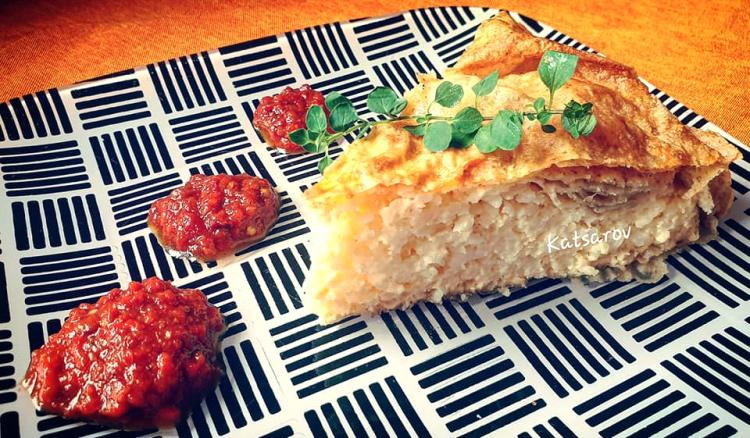
Rhodope Klin from Trigrad
A traditional Rhodope layered pastry with a rice, cheese, egg and yogurt filling, made after Grandma Kadrichka's recipe from the village of Trigrad.
Ingredients
| 250-300 g | flour (for the dough) | |
| 200 ml | water, slightly warm (for the dough) | |
| 1 tsp | 5 ml | vinegar (for the dough) |
| 1 coffee spoon | salt (for the dough) | |
| 200 g | rice (for the filling) | |
| 300 g | cheese (for the filling) | |
| 200 g | yogurt (for the filling) | |
| 6 | eggs (for the filling) | |
| 100 g | butter (for the filling) | |
| 1 coffee spoon | baking soda (for the filling) | |
| to taste | salt (for the filling) |
Instructions
Trigrad is a place that has for centuries remained unchanged, far from the noisy and hurried modern world. Every visit there is unforgettable - magnificent nature, hospitality and delicious Rhodope cuisine, from which today we will prepare a Trigrad klin after Grandma Kadrichka's recipe. The recipe can also be made with ready-made "kapani" phyllo sheets (3 pieces) or with a packet of fine phyllo, to save yourself the kneading and rolling, but there will be a certain change in the taste.
- In a pot put the washed rice and add water in a ratio of 1 part rice to 3 parts water (600 ml in this case). Salt delicately, but be careful, because the cheese is also salty! Set the rice to boil. When it boils, reduce the heat to medium and boil the rice covered almost until done. It should be a touch firmer and almost out of water. The proportion I give (1:3) is precise, and if you boil the rice correctly you will not have to add water, nor will the rice stay raw.
- Add half of the butter to the hot rice together with 1/3 of the crumbled cheese. Stir constantly until the butter and cheese melt from the heat. This way we flavor the "bare" rice, which at this stage craves aromas. This is one of Grandma Kadrichka's secrets for a good Trigrad klin. If you wait for the rice to cool and then add the cheese - the unique Rhodope taste will not come out.
- Leave the rice uncovered to cool, and meanwhile knead a dough as for banitsa from: the flour, the water, the vinegar and the salt. Leave to rest under a cloth / foil for 15 minutes and divide into two balls - one larger than the other. Roll out 2 sheets. The larger sheet will be the base of the klin.
- When the filling has cooled, add the eggs and the remaining 2/3 of the crumbled cheese. Finally, add the baking soda to the yogurt, stir well and pour it into the rice. Stir one last time and taste for salt. Now we come to the question of the spices. Grandma Kadrichka makes the patatnik with spearmint (dzhodzhen), but leaves the klin without spices. It should taste of fresh eggs, of homemade cheese and butter. What better spice than that?!
- In a greased baking tin (mine is 30 cm in diameter) place the larger sheet so that its edges hang over the rim of the tin.
- Pour in the rice filling and spread it evenly.
- Fold the edges of the bottom sheet inward and brush them with a little butter.
- Place the smaller sheet on top and pinch its edges together with those of the bottom sheet.
- Authentically, the klin is baked in the tin on top of the stove, because it is made in large tins for the guests and does not fit any oven. The tin is periodically turned so that it bakes evenly. When the klin is baked, it is flipped with the help of a wooden board or another tin. The bottom of the baking tin is greased again and then the klin is slid back into the tin so that it bakes on the other side too. When the klin is flipped, the top baked side is brushed generously with butter. Do not grease the tin with butter, because when baking on top of the stove it will burn and give a bitter taste.
- In modern conditions the klin can be baked in the oven with only the bottom element and this traditional flipping can be done.
- If you want to save yourself time and fuss around the oven - you can bake it top and bottom at the same time and you will still have a tasty klin, but it will not be exactly like the Trigrad one. If we choose to bake it from both sides in the oven, the recipe continues like this:
- Brush the top sheet with one beaten yolk in 1-2 tbsp water (in the filling of the klin we put 5 yolks and 6 whites), then with a sharp knife make holes in a few places in the top sheet so the steam can escape.
- Place in an oven preheated to 170°C and set to bake from both sides. Bake the klin until done (about 40 min).
- Take out the Rhodope klin and brush the top sheet generously with butter. Serve with a good homemade lyutenitsa.
ADDITIONAL NOTES: If we use "kapani" phyllo sheets - we put 2 sheets for the base (buttering between them), then the filling, fold the edges of the bottom sheets inward, butter them too, place the top sheet and tuck its edges under the bottom sheets. If we use fine rolled phyllo - then first divide the sheets from the packet into two halves, equally. On the bottom of the tin put a few whole sheets (greasing between them) and arrange them so that their edges hang over the baking tin. Then randomly tear the remaining sheets from one half into smaller pieces and distribute them in the tin. On top place the filling and in reverse order - tear part of the other half of the sheets and arrange randomly. Then fold the edges of the bottom sheets inward and sprinkle them with oil / melted butter, and finally leave a few whole sheets with which to cover everything, tucking their edges under the bottom sheets.
DID YOU KNOW THAT... In the Thracian culinary tradition there is a banitsa that is a "twin sister" of the Rhodope klin and is made by exactly the same recipe, but instead of rice it uses boiled bulgur and is logically called "Bulguritsa", but about that another time. Thank you (Spolay Vi)! Dr. Katsarov (psychiatrist and psychotherapist)