Roast Duck with Orange Glaze and Wine Sauce
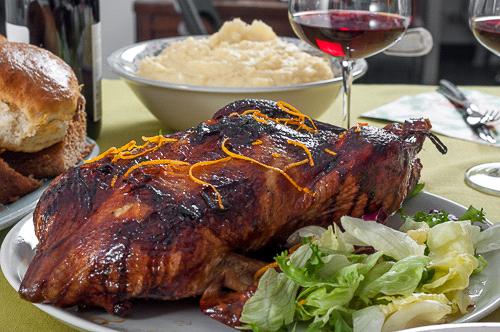
Whole roast duck brushed with a caramel-orange glaze and served with a rich reduced wine sauce made from the giblets.
Ingredients
| 1 | duck (2.6 kg), with giblets | |
| 1 | orange | |
| 50 g | fine caster sugar | |
| 45 ml | white wine vinegar | |
| 60 ml | orange liqueur | |
| — | salt and freshly ground black pepper | |
| 2 tbsp | 30 ml | olive oil (for the sauce) |
| — | duck giblets and trimmings (without the fat) | |
| 1 tbsp | 15 ml | butter |
| 2 | carrots, cut into large pieces | |
| 1 | onion, cut into large cubes | |
| 1 sprig | fresh thyme | |
| 1 | bay leaf | |
| 10 | black peppercorns, crushed in a mortar | |
| 2 tbsp | 30 ml | raspberry vinegar or red wine vinegar |
| 20 g | flour | |
| 150 ml | red wine | |
| 600 ml | chicken stock | |
| 600 ml | water | |
| 1/2 tsp | 2.5 ml | juniper berries |
Instructions
Note from the author: I made a wine sauce to go with it and served it with mashed potatoes, to which I added butter and cream and seasoned with bay leaf, nutmeg and black pepper. The issue I mentioned is the fat the duck releases while roasting. The bird (if not wild) has a lot of fat that we need to get rid of, and the solution is to roast it on a rack so the excess fat drips into a tray beneath. What worries me is the fat collecting in the tray burning. I need to deal with this problem, and for now the only thing I can think of is to discard the fat periodically, which is not very convenient but is at least some kind of solution. If I turn a blind eye to the smell I detected for two days after roasting the duck, this was delicious, even a very tasty suggestion for the Christmas table. The listed quantities are for 6-8 servings. If the duck is frozen, it will need about 48 hours to thaw in the refrigerator. The giblets that come with the duck are removed and reserved for the wine sauce. Heat the oven to 150°C. Prepare the oven rack and an oven tray, or a smaller rack set over a tray. Trim the excess fat and skin from the duck. Prick the surface of the duck (over the skin) in several places with a fork. Season with salt and freshly ground black pepper all over, including inside its cavity. Place the duck on the rack breast-side up; the wings should stay tight against the body and be tucked slightly underneath toward the back. Cross the legs at the front and tie with natural thread or twine. Place the rack with the duck in the preheated oven. Put a tray underneath the rack to catch the dripping fat. Cover the duck loosely with aluminium foil and roast for 1 hour and 30 minutes. Meanwhile, prepare the orange glaze. Peel the zest from the orange so that the white pith beneath it is not included. It is easiest to use a special tool for this, but it can be done with a potato peeler or a knife, then the strips of peel are cut into thinner strips. Juice the orange. Set the peel and juice aside. In a small saucepan, combine the sugar and vinegar. Heat over high heat, stirring, until the sugar melts and the mixture begins to boil. Once it boils, stop stirring and let the syrup boil for a few minutes until it takes on a caramel colour. Add the orange juice and bring the mixture back to a boil. When it boils, add the orange peel and orange liqueur. Boil for 2-3 minutes and remove from the heat. After an hour and a half, remove the duck from the oven and discard the fat collected in the tray. (At this stage there wasn't much fat for me; most of it rendered during the second stage of roasting.) Increase the oven to 200°C. Return the duck to the oven, uncovered, and brush its entire surface with the orange glaze. Roast for about 40 minutes, brushing periodically with the glaze. The duck should turn golden-brown on the surface, and when the top of the thigh is pierced, clear juices should run out. Remove from the oven and place on a plate. Cover with aluminium foil and let rest for 20-30 minutes. For the sauce: Heat the olive oil in a pot over medium heat. Fry the duck giblets and trimmings in it for 10-15 minutes until nicely browned. Add the butter, carrots, onion, the whole sprig of thyme, the bay leaf and the peppercorns. Cook until caramelised, stirring from time to time. Pour the vinegar into the pot and sprinkle everything with the flour. Stir well and cook over low heat for 2-3 minutes. Add the wine, stock and water. Bring the mixture to a boil, periodically skimming off the foam that forms on the surface. When the sauce boils, add the juniper berries. Simmer uncovered for about 45 minutes over medium to low heat. Skim periodically if needed. When the sauce is ready, it should have thickened and reduced by a little more than 1/3 of its original volume. Strain through a fine sieve.