
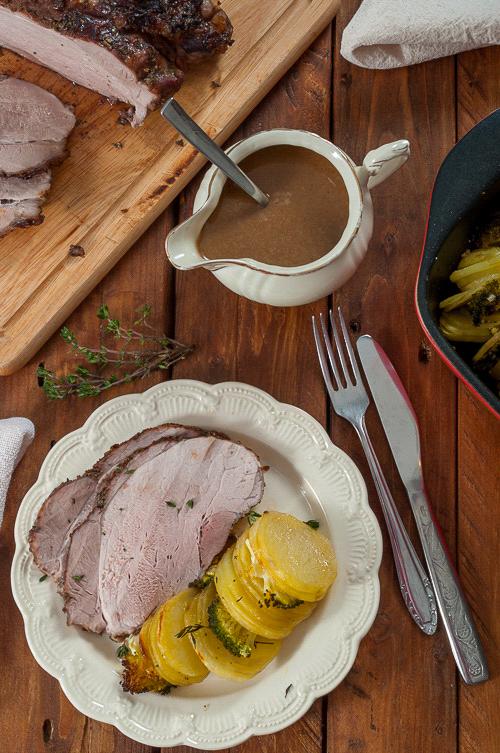
Roast Pork Leg with Madeira Onion Sauce
Herb-rubbed roast pork leg cooked over onions and served with a rich Madeira onion sauce made from the pan juices.
Ingredients
| 1.2 kg | pork leg meat | |
| 1 tbsp | 15 ml | chopped fresh rosemary |
| 1 tbsp | 15 ml | chopped fresh thyme |
| 1 | garlic clove, finely chopped | |
| 1 tbsp | 15 ml | liquid herbal honey |
| 1 tsp | 5 ml | pomegranate molasses |
| 1 tsp | 5 ml | Dijon mustard |
| 2 tsp | 10 ml | ground sea salt (or 1 tsp table salt) |
| 1/4 tsp | 1.3 ml | freshly ground black pepper |
| 5 | onions, cut into thick half-moons | |
| 100 ml | Madeira | |
| 200 ml | boiling water | |
| 1 tsp | 5 ml | cornstarch, dissolved in a little cold water |
| 50 g | cold butter |
Instructions
Roasting principle: The meat goes into an oven preheated to 220°C and roasts for 20 minutes. (If the piece of meat has skin, or a thicker layer of fat is left under the skin, roasting can start at higher temperatures - 240°C to 250°C.) After that, roasting continues at 180°C for 25 minutes per 500 grams of meat. Since ovens vary, using a thermometer gives the best results. Even better is to use a probe left in the meat during roasting. The thermometer should be inserted into the thickest part of the meat, and if using a probe, its tip should reach the centre of the piece. The measured internal temperature of the pork must exceed 60°C to register doneness, unlike beef, where for rare and medium it is desirable that the temperature not exceed 60°C. Regardless of the meat and the temperature you want it to reach, there is a catch you should know. When the meat is taken out of the oven, its internal temperature keeps rising and can climb another 3°C-4°C. This is especially noticeable when you want the meat rare. These four degrees can change everything. So keep in mind that it is desirable to take the meat out of the oven when its temperature is 3°C below the desired one. Example - I wanted the meat in this recipe to reach 65°C. I took it out of the oven when the thermometer showed 62°C. I left the meat in the tin and covered it with aluminium foil until it reached 65°C. While the meat rests, juices are released into the tin that make the sauce even tastier. The stated quantities are enough for 6 portions. For the meat: The meat is taken out of the refrigerator 20-30 minutes ahead to warm to room temperature. The oven is heated to 220°C. Prepare a tin whose bottom is greased with a little oil. The onions are cut into thicker half-moons and placed in the middle of the tin, in a single row. In a bowl, mix the rosemary, thyme, garlic, honey, pomegranate molasses, mustard, salt and pepper. Stir well. The meat is tied with cotton thread or twine to give it a tight shape that will hold during roasting. It is important to tie it so that slicing the meat after roasting is done across the muscle fibres. Rub it on all sides with the mixed spices. Place it in the tin on top of the onions. Put in the preheated oven and roast for 20 minutes. Then reduce the oven to 180°C and continue roasting for another hour, or until the internal temperature of the meat reaches 62°C. Remove the tin from the oven, cover the meat with aluminium foil and leave it for 8-10 minutes. Then move the meat to a warmed plate, again covered with aluminium foil, and keep in a warm place while the sauce is prepared. For the Madeira onion sauce: Once the meat is removed from the tin, place it over two burners (if this is not possible, transfer everything from the tin to a saucepan) and heat over high heat until the juices boil. Add the Madeira and scrape the bottom of the tin with a wooden spatula. Stir everything and let it simmer 2-3 minutes. Add the water and also let it boil. Pour in the cornstarch, stir well and cook 3-4 minutes. Turn off the burners and add the butter to the sauce. Stir until it melts. Remove the tin from the burners. At this stage the sauce can be strained and the onion served separately. Or everything is poured into a food processor and blended. The mixture is passed through a sieve, and the onion pulp remaining in the sieve is discarded. If necessary, warm the sauce before serving. The meat is sliced into thin pieces, with the cuts made across the muscle fibres. Serve with the sauce and a suitable side dish. Leftover meat is stored in the refrigerator. It is delicious the next day too, cold for sandwiches or finely chopped in a salad.