
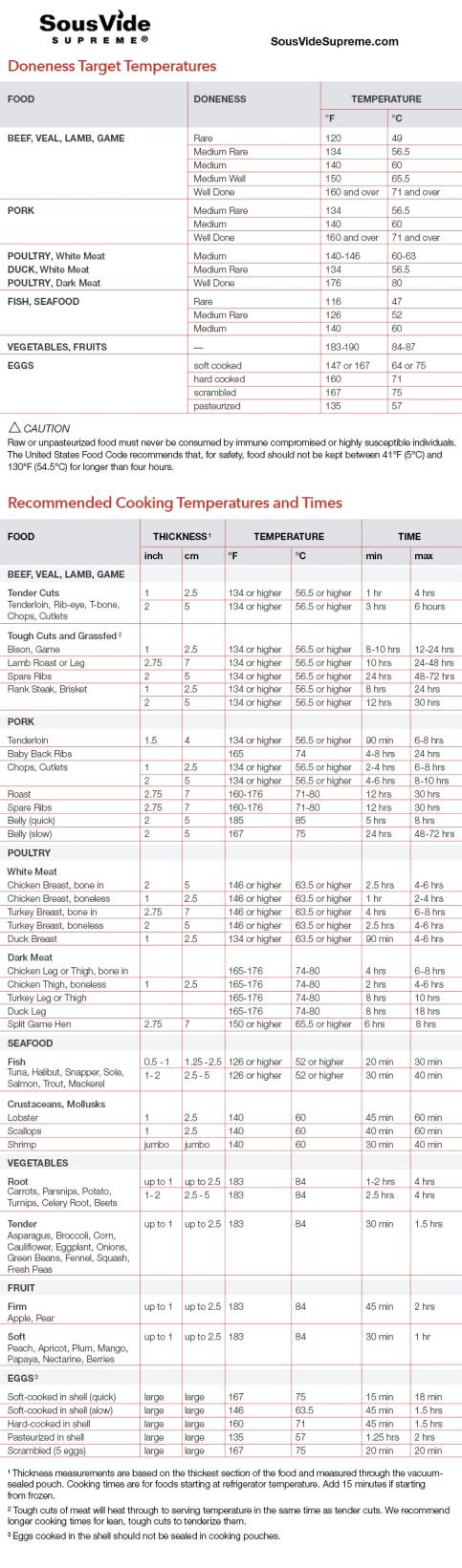
Time and Temperature
Unique online calculator! Time according to the thickness of the meat.
Ingredients
Instructions
MINIMUM TIME
-
Tenderize tough meats, for example beef brisket and short ribs, benefit from longer cooking times. As Douglas Baldwin taught us, tough cuts can be made tender and still be a medium-rare to medium doneness by converting collagen (the connective tissue that holds muscle fibers, bones, and fat in place) into tender gelatin by holding the meat at between 130°F/55°C and 140°F/60°C for six hours to three days. At below 140°F/60°C, enzymes (such as collagenases) can significantly increase tenderness after about six hours. Above about 130°F/55°C, heat will begin breaking down collagen into gelatin and reduce inter-fiber adhesion; the amount of time needed to tenderize decreases exponentially as the temperature increases, so it'll take about 2 days to make a chuck roast fork-tender at 130°F/55°C and less than an hour in a pressure cooker. For more information, see §2 of his guide or his review article.
-
Pasteurize the food by holding it in the water bath until any foodborne pathogens have been reduced to a safe-level. This only works if target cooking temperature is above 126.1°F/52.3°C. Below this temperature, food needs to be served immediately and it won't be pasteurized. Pasteurizing is required for the Cook - Chill - Freeze - Reheat sous vide method that we explain in Finishing Food After Cooking Sous Vide lesson.
MAXIMUM TIME
There is also a maximum time that you can hold the food in the sous vide water bath and it varies by food type. In some foods, such as chicken, fish and some tender cuts, enzymes may cause a mush-like texture if held in the bath for too long as they break down too much of the connective tissue and inter-fiber adhesion. Chicken becomes mushy after about 4 hours while for fish it may be just a few minutes.
For this reason, fish and tender cuts usually just need to be brought up to temperature and then served. As Douglas Baldwin explains, this frequently means that fish and tender cuts cannot be pasteurized — that is, reduce any foodborne pathogens to a safe-level — and made safe for immuno-compromised people. Some tender cuts, such as poultry, should always be pasteurized since they're likely to make even healthy people sick.
Beef and tougher cuts can be held in the sous vide bath for long times and they usually benefit from this as explained before. Over time the connective tissue in the muscle will eventually weaken, but such a change might take days at such low temperatures.
From http://www.molecularrecipes.com/sous-vide-class/sous-vide-cooking-time-temperature/